Exodus 5:11
protestant「Go yourselves, get you straw where ye can find it; for nought of your work shall be diminished.」
Exodus 1:16
protestant「and he said, When ye do the office of a midwife to the Hebrew women, and see them upon the birth-stool; if it be a son, then ye shall kill him; but if it be a daughter, then she shall live.」
Exodus 25:29
protestant「And thou shalt make the dishes thereof, and the spoons thereof, and the flagons thereof, and the bowls thereof, wherewith to pour out: of pure gold shalt thou make them.」
Exodus 16:13
protestant「And it came to pass at even, that the quails came up, and covered the camp: and in the morning the dew lay round about the camp.」
Exodus 27:11
protestant「And likewise for the north side in length there shall be hangings a hundred cubits long, and the pillars thereof twenty, and their sockets twenty, of brass; the hooks of the pillars, and their fillets, of silver.」
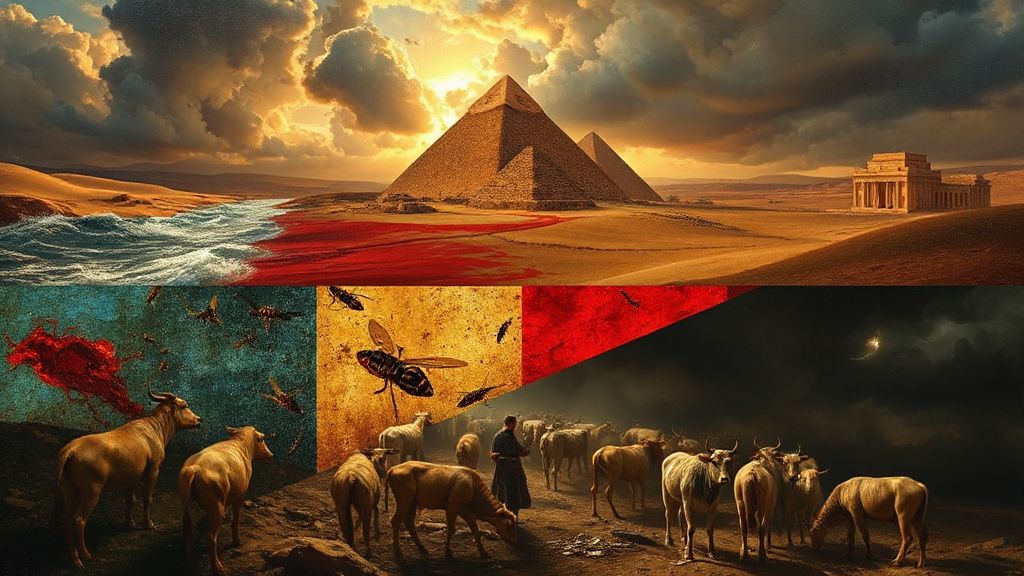
Exodus 9:3
protestant「behold, the hand of Jehovah is upon thy cattle which are in the field, upon the horses, upon the asses, upon the camels, upon the herds, and upon the flocks: there shall be a very grievous murrain.」
Tent of Meeting
allThe sacred tent where God met with Moses and His people, symbolizing divine presence and the center of Israelite worship in the wilderness.
Lovingkindness (Chesed)
allGod's steadfast, covenantal loyal love extended to thousands of generations of those who love Him and keep His commandments, summing up His grace and faithfulness.
Rock
allThe rock at Horeb struck to bring forth water, a type of Christ the spiritual Rock smitten to pour out life (1 Cor 10:4).
Ten Commandments
allThe ten commandments spoken directly by God at Mount Sinai, forming the core terms of the Mosaic covenant and the foundation of Israel's faith and moral life.
Ark of the Covenant
allThe most sacred Israelite object, containing the tablets of the Ten Commandments, symbolizing God's presence with Israel. Its acacia wood overlaid with pure gold reflects the union of divine and human.
Angel of the LORD
allThe divine messenger of YHWH who often appears indistinguishable from God Himself in the OT, frequently understood as a Christophany revealing the pre-incarnate Christ.
Why does only the tenth plague require the special act of marking the doorposts with blood, and what makes this night different?
The blood-marked night stands apart as the night of redemption itself.
Is the commandment 'You shall not murder' absolute in all circumstances?
Examining the application of 'You shall not murder' in contexts of war, capital punishment, and self-defense.
How has Catholic tradition connected the ten plagues of Egypt to the Passion of Christ?
Reading the plagues as typological foreshadowings of Christ's redemptive suffering.
Why is 'You shall not covet' a commandment about inner morality?
The commandment against coveting reveals God's concern for inner motives.
How does Catholic tradition understand the 'I AM' revelation from the burning bush?
The self-disclosure in the fire—how does it connect to core Christological truth?
Why is 'I am the LORD' in Exodus 20:2 the foundation of the Ten Commandments?
The relationship between knowing God and the order of commandments
🎬 Courseprotestant
Exodus 20:1-17
Exodus · Ch.20
Exodus 20:1-17 The Ten Commandments
V 22min
Exodus and LawMt. Sinai