Exodus 21:19
protestant「if he rise again, and walk abroad upon his staff, then shall he that smote him be quit: only he shall pay for the loss of his time, and shall cause him to be thoroughly healed.」
Exodus 11:10
protestant「And Moses and Aaron did all these wonders before Pharaoh: and Jehovah hardened Pharaoh's heart, and he did not let the children of Israel go out of his land.」
Exodus 30:21
protestant「So they shall wash their hands and their feet, that they die not: and it shall be a statute for ever to them, even to him and to his seed throughout their generations.」
Exodus 9:1
protestant「Then Jehovah said unto Moses, Go in unto Pharaoh, and tell him, Thus saith Jehovah, the God of the Hebrews, Let my people go, that they may serve me.」
Exodus 27:12
protestant「And for the breadth of the court on the west side shall be hangings of fifty cubits; their pillars ten, and their sockets ten.」
Exodus 17:13
protestant「And Joshua discomfited Amalek and his people with the edge of the sword.」
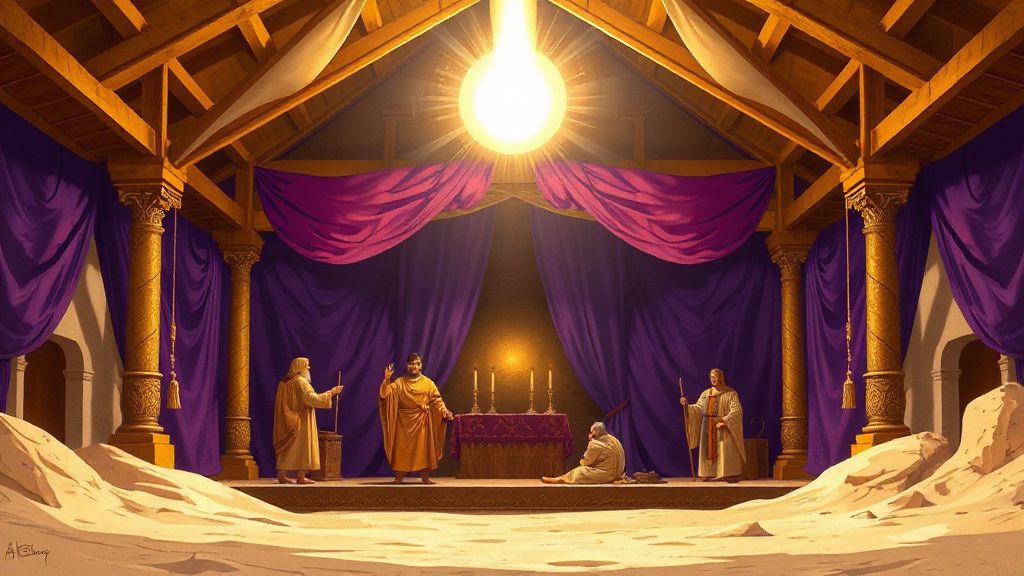
Tent of Meeting
allThe sacred tent where God met with Moses and His people, symbolizing divine presence and the center of Israelite worship in the wilderness.
Altar of Burnt Offering
allThe square bronze altar in the tabernacle courtyard used for sacrifices and atonement, central to Israel's worship as the place where sin is atoned through sacrifice.
Heave Offering (terumah)
allתְּרוּמָה denotes a portion lifted and separated for God; used here for voluntary gifts toward the Tabernacle, symbolizing willing devotion.
Tabernacle
allThe dwelling place God commanded Israel to build so He might dwell among them. Central OT symbol of divine presence, later seen as typological of Christ tabernacling among humanity.
Anointing Oil
allSacred oil used to consecrate the tabernacle and its furnishings, symbolizing the Holy Spirit's presence and consecration.
Ark of the Covenant
allThe most sacred Israelite object, containing the tablets of the Ten Commandments, symbolizing God's presence with Israel. Its acacia wood overlaid with pure gold reflects the union of divine and human.
Why did Moses and Aaron wait for God's specific command before each plague, rather than acting on their own initiative?
The rhythm of obedience behind each plague reveals God's precise sovereignty.
How does Catholic tradition understand the 'I AM' revelation from the burning bush?
The self-disclosure in the fire—how does it connect to core Christological truth?
How does Catholic tradition understand the 'I AM' revelation from the burning bush?
The self-disclosure in the fire—how does it connect to core Christological truth?
What attribute of God does Exodus 33:20 reveal—Moses cannot see His face?
The unseen God reveals Himself to Moses in the most intimate way.
How does Judaism emphasize the commandment to honor parents?
Honoring parents is a foundational ethic in Judaism.
What does it mean to "remember" and "keep" the Sabbath today?
Two seemingly opposed commandments unite in Jewish observance.
Exodus 20:1-17
Exodus · Ch.20
Exodus 20:1-17 The Ten Commandments